There’s a Formula Behind Your Pain. The Insurer Already Knows It.
What would you do if you found out the insurance company had already assigned a number to your suffering before you ever picked up the phone?
Most people I talk to in my office have a version of the same story. They were rear-ended at a stoplight, or they slipped on a wet floor at a grocery store, and now they’re living with back pain, missed work, and a stack of medical bills. Then an adjuster calls—friendly, professional—and somewhere in that conversation, a number gets floated. It sounds reasonable enough. But something feels off.
What feels off is that the adjuster already ran the math. And they didn’t run it in your favor.
I’ve spent years doing pre-litigation case valuation reviews, which means I sit across from injured people and walk them through exactly how that number was built. Not to scare them. To arm them. Because the moment you understand the framework, the settlement discussion stops feeling like a verdict handed down from on high and starts feeling like what it actually is: a negotiation.
The Gap Between What You Feel and What Gets Counted
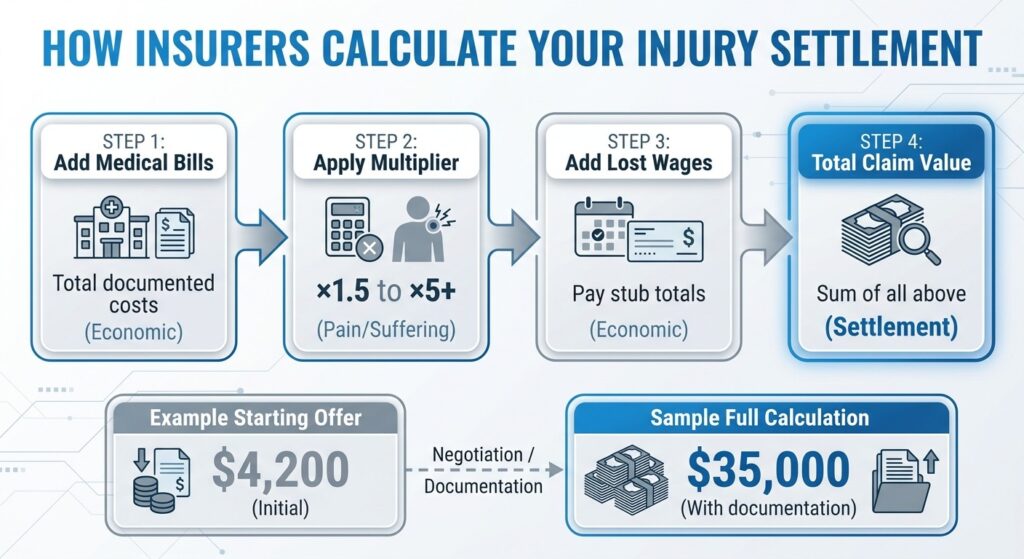
Here’s the scenario I see constantly. Someone comes in two months after a car crash. They’ve been to urgent care, started physical therapy, missed three weeks of work. They feel like their life has been turned upside down. The insurer’s first offer is $4,200.
They’re stunned—not because the number is necessarily final, but because they have no idea how it was calculated or whether it’s even in the right ballpark. That uncertainty is exactly where insurers want you.
Personal injury compensation breaks into two distinct buckets:
| Damage Type | What It Covers | How It’s Measured |
|---|---|---|
| Economic damages | Medical bills, lost wages, future care costs, out-of-pocket expenses | Documented receipts, pay stubs, invoices |
| Non-economic damages | Pain and suffering, emotional distress, loss of enjoyment, loss of consortium | Multiplier formulas, narrative evidence, physician notes |
Economic damages have receipts. A plaintiff can point to a pay stub and a hospital bill and say: here is what this crash cost me in real dollars. Non-economic damages are harder to pin down, which is precisely why insurers prefer to keep the conversation vague. That’s where the formula enters the picture.
How the Math Actually Works
The most widely used starting point is called the multiplier method.
Add up your medical special damages—the bills directly tied to treating your injury—and multiply that figure by a number, typically between 1.5 and 5, to estimate the value of your pain and suffering. Then add your economic damages on top. California legal aid guidance on damages calculation confirms this structure, noting that in extreme cases the multiplier can climb above 5.
A simple example:
- Medical bills: $10,000
- Multiplier applied: ×2
- Pain and suffering estimate: $20,000
- Lost wages: $5,000
- Rough starting figure: $35,000
That’s the settlement calculation framework most people never see spelled out.
The multiplier isn’t random, but it isn’t objective either. What moves it up or down?
- Severity and permanence of the injury
- Consistency of treatment and quality of documentation
- Clarity of liability—disputed fault pulls the number down
- Credibility of the injured person as perceived by the adjuster
- Gaps in medical care that an insurer can frame as evidence the injury wasn’t serious
A soft-tissue whiplash with a clean recovery and two months of physical therapy might justify a 1.5 multiplier. A herniated disc requiring surgery, with documented functional limitations affecting someone’s ability to work, sleep, and parent their kids—that’s a different conversation entirely. Procedures like percutaneous discectomy can substantially shift case value upward, sometimes into ranges that bear little resemblance to the initial offer.
The multiplier method is a starting point, not a verdict. That distinction matters enormously.
The Insurer’s View vs. What You’re Actually Owed
The insurance company is not calculating what your injury is worth to you. They’re calculating what they think they can settle for.
Those are not the same number.
Insurers—particularly large carriers—often use proprietary software called Colossus to generate settlement ranges. Colossus is a database-driven program that takes in information about your injury type, treatment codes, diagnosis codes, and documented impairments, then spits out a suggested range based on historical settlements for similar claims.
What Colossus doesn’t know:
- That you’re a 47-year-old who coaches your daughter’s soccer team and can no longer kneel on the field
- That the pain keeps you up at night
- That you’ve been quietly terrified about whether you’ll ever feel normal again
What Colossus knows is what adjusters enter into it. And adjusters are trained to enter information conservatively.
A personal injury attorney boston who handles these cases regularly understands how to counter this. The antidote to Colossus isn’t anger—it’s documentation. Detailed medical records that describe functional limitations in plain language. Treating physician notes that connect your diagnosis to your daily life. A pain journal. Statements from family members. Wage records. Anything that makes the human cost of your injury visible to a system designed to reduce it to data points.
What isn’t documented doesn’t exist in the insurer’s calculation. Full stop.
How a Claim’s Value Shifts Over Time
Settlement value isn’t static. This surprises people almost every time I explain it.
They assume there’s a fixed number sitting in a file somewhere, waiting to be revealed. In reality, the range moves as the case develops—sometimes dramatically. Early in a claim, before you’ve finished treatment and before you know whether your injury is permanent, neither side has enough information to negotiate accurately.
This is why accepting a quick settlement offer before reaching what doctors call “maximum medical improvement” is one of the most common and costly mistakes injured people make. Once you sign a release, that’s it. If your condition worsens, you cannot go back.
How the picture sharpens as a case develops:
- Week 1–4: Soft-tissue presentation, limited records, wide uncertainty in valuation
- Week 5–10: Imaging may reveal structural damage not visible at first presentation — a peer-reviewed study published on PubMed found that vertebral compression fractures and disc herniations were frequently missed as an initial diagnosis after accidents, only emerging on MRI weeks later
- Month 3–6: Treatment patterns establish whether recovery is progressing or plateauing
- Maximum medical improvement: Full economic damages become calculable; negotiation can proceed on solid ground
Each development shifts the negotiating range. Liability facts get clearer—or murkier. Witness statements get taken. Surveillance footage gets reviewed. The insurer’s first offer almost always reflects the minimum they think you’ll accept, not the maximum they’d pay to avoid litigation. That gap is where negotiation lives.
Damage calculation guides consistently show that severe, long-term injuries with clear liability and strong documentation command multipliers at the higher end of the range, sometimes well above 5. Understanding where your case sits on that spectrum—and why—is the foundation of any meaningful negotiation.
The Objections I Hear Most Often
“I don’t want to seem greedy.”
This comes up more than you’d think. Seeking fair compensation for documented losses isn’t greed. Medical bills are real. Lost wages are real. The pain that kept you from sleeping, from working, from being present for your family—that’s real too. The legal system provides a mechanism to make injured people whole. Using it isn’t a character flaw.
“The insurer said their offer is fair.”
Adjusters are professionals. They’re also employees of a company whose financial interest is in paying out less, not more. “Fair” in their framing means fair to their bottom line. The settlement valuation framework that both sides use gives you the tools to evaluate that claim yourself rather than taking it on faith.
“I don’t want to go to court.”
Most personal injury cases never go to trial. The vast majority settle. Having an attorney doesn’t mean you’re headed to a courtroom—it means you’re negotiating from a position of knowledge rather than anxiety.
What to Do With This Information
If you’re sitting with an offer right now and it doesn’t feel right, here’s where to start.
Gather your documentation first. Pull together every medical bill, every explanation of benefits, every pay stub showing missed work, every prescription receipt, every note you’ve made about how the injury has affected your daily life. That documentation is the raw material of your claim’s value. The more complete it is, the less room an adjuster has to minimize what happened to you.
Know where you are in treatment. If you haven’t reached maximum medical improvement, you may not yet know the full scope of your economic damages—which means you don’t yet know your full claim value. Settling before that point is almost always premature.
Assess the liability picture honestly. If fault is genuinely disputed, that affects the settlement range in ways that have nothing to do with your injury’s severity. A strong liability position supports a higher multiplier. A contested one creates leverage for the insurer.
Talk to an attorney before you respond to a significant offer. Not because litigation is inevitable. Because understanding your actual range—built on your actual records—is the only way to negotiate from solid ground rather than guesswork.
The formula exists. Now you know how it works.
That changes the conversation.